Quick answer
On your first trip to Europe under the Entry/Exit System (EES), the border check includes biometric registration. You give your personal data, and border officers photograph your face and/or scan your fingerprints. Your passport is not stamped. The digital record replaces the stamp and counts your short stay of no more than 90 days in any 180-day period.
Checked on 20 November 2026 against travel-europe.europa.eu (official EU EES pages).

On this page
Key facts
- The EES has been fully in operation since 10 April 2026. It was introduced in stages from 12 October 2025.
- It applies when you cross the external border of the 29 European countries using the EES for a short stay.
- Cyprus and Ireland still stamp passports manually.
- If you refuse to give biometric data, you will be refused entry.
- A short stay means no more than 90 days in any 180-day period. This is counted as one period across all countries using the EES.
The EES is a different system from ETIAS. The EES registration happens at the border. For the full comparison, see ETIAS and the EES: the difference.
Get an e-mail when ETIAS starts
ETIAS has no start date yet. Leave your e-mail address and we will write to you when the EU announces the start date and again when applications open.
Who goes through EES biometric registration
The EES does not apply to:
- nationals of the countries using the EES, or of Cyprus and Ireland
- holders of a residence permit
- holders of a long-stay visa
If you hold two passports, which one you use at the border matters. See ETIAS and dual citizenship: which passport to use.
What to prepare before your first trip
- Your passport. The EES records data from your travel document. Use the same passport you plan to travel on. For document rules, see ETIAS passport and document requirements.
- Your travel plan. Know how many days you will spend in the countries using the EES. All of these countries share one 90-day limit within any 180-day period.
- Information on self-service options. Some countries offer self-service equipment at the border. Some also offer a mobile app for entering data in advance. Check what your country of arrival offers, as not every country offers both.
Step by step: your first EES border check
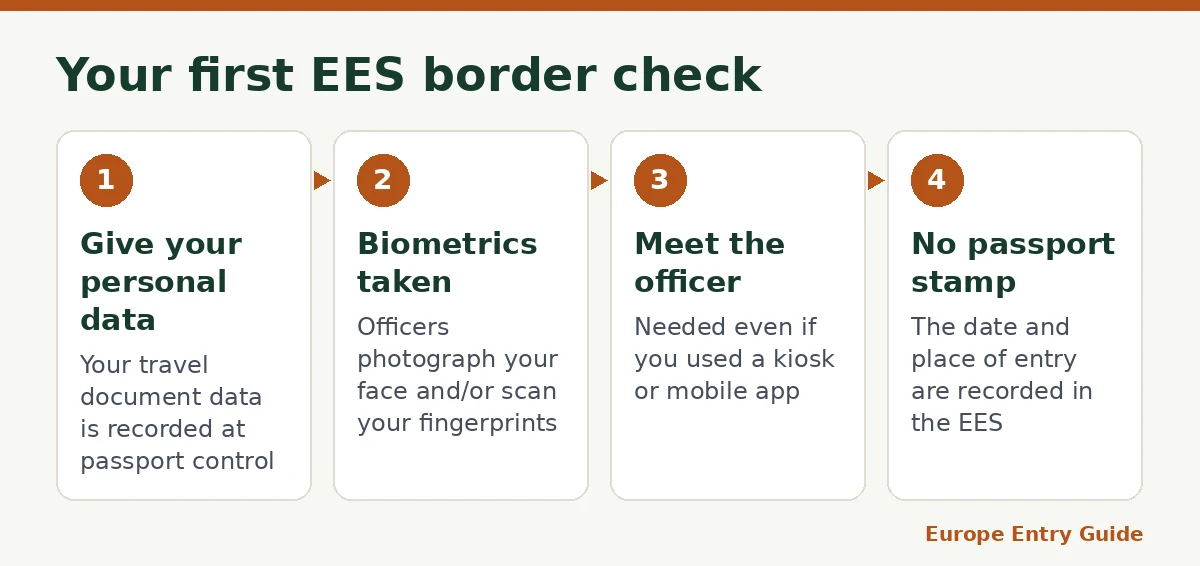
- Go to passport control at your first entry point. This is where you enter the area of the countries using the EES from outside, for example at an airport, port or land border.
- Give your personal data. Your travel document data is recorded. You may be able to enter some of it in advance using a self-service kiosk, where available, or a mobile app, if the country offers one. This can make the process faster.
- Have your biometrics taken. Border officers photograph your face and/or scan your fingerprints. This is the EES biometric registration.
- See the border officer. Even if you used a kiosk or an app, you will still meet a passport control officer on your first registration.
- Continue without a stamp. Your passport is not stamped. The date and place of your entry are recorded in the EES.
- Leave the area at the end of your stay. The date and place of your exit are also recorded.
What happens on later trips
Some countries run national facilitation programmes. These are privileges, not rights. No country is obliged to offer one. They apply only in that country, unless countries have an agreement between them. Access is granted for a maximum of 1 year. It is renewed after a yearly review, for a total of no more than 5 years.
What the EES records about you
| Data | When it is recorded |
|---|---|
| Travel document data | At your first registration |
| Facial image and fingerprints | At your first registration |
| Date and place of entry | Every time you enter |
| Date and place of exit | Every time you leave |
| Refusal of entry | If you are refused entry |
Common mistakes on a first EES trip
- Assuming a kiosk or app replaces the officer. On your first registration, you still meet a passport control officer.
- Assuming every country has an app. A mobile app is used only where the country offers one.
- Counting days per country. The 90 days in any 180-day period are counted as one period across all countries using the EES.
- Refusing fingerprints or a face photo. If you refuse to give biometric data, you will be refused entry.
- Staying beyond your authorised stay. If you overstay, you are flagged as an overstayer and your data is added to a list automatically. National law can then apply. This can include removal, fines, detention or a ban on re-entry.
Time limits and data retention
| Item | Limit or retention period |
|---|---|
| Short stay | No more than 90 days in any 180-day period, across all countries using the EES |
| Records of entries, exits and refusals | Kept for 3 years from the date they were created |
| Individual file with your personal data | Kept for 3 years and 1 day from your last exit or refusal of entry |
| Individual file if no exit was recorded | Kept for 5 years from the end of your authorised stay |
| National facilitation programme access | Up to 1 year at a time, renewable after a yearly review, for no more than 5 years in total |
For more answers about travel authorisation and border rules, see ETIAS questions and answers.
Frequently asked questions
Can I register for the EES before I travel?
You cannot complete the registration in advance. However, you may be able to enter some data beforehand using a self-service kiosk at the border, where available, or a mobile app, if the country offers one. You will still meet a passport control officer.
What happens on my next trip after registration?
Once you are registered, the process can be quicker. If you hold a biometric passport, you may be able to pass faster through a self-service system. If your digital record is clear, a border officer is usually not needed.
Is the EES the same as ETIAS?
No. The EES records your entries and exits at the border. ETIAS is a separate system. For the difference, see ETIAS and the EES: the difference.
Sources
- How does the EES work? (travel-europe.europa.eu)
- Data held by the EES (travel-europe.europa.eu)
- What is the EES? (travel-europe.europa.eu)
- To whom does the EES not apply? (travel-europe.europa.eu)
- National facilitation programmes (travel-europe.europa.eu)
This guide is general information, not legal or immigration advice. Europe Entry Guide is an independent website and is not connected with the European Union.
Found a mistake or outdated information on this page? Report it to the editors