Quick answer
ETIAS for US citizens is not in operation yet. No applications are being accepted. Once ETIAS starts, American travellers with a US passport will need a travel authorisation before visiting 30 European countries. The fee will be EUR 20.
Checked on 18 November 2026 against travel-europe.europa.eu (official ETIAS website of the European Union).
- Where: 30 European countries. Ireland is not one of them.
- Fee: EUR 20. Applicants under 18 or over 70 will not pay.
- Validity: up to 3 years, or until your passport expires, whichever comes first.
- How: online, through the official ETIAS website or the official mobile app.

On this page
Who will need ETIAS and who will not
ETIAS depends on the passport you use to enter Europe. Your place of residence does not decide it. The table covers the most common situations for US passport holders.
| Your situation | ETIAS once it starts? | Note |
|---|---|---|
| US citizen travelling on a US passport to one of the 30 ETIAS countries | Yes | Apply before you travel. |
| US citizen under 18 | Yes | No fee. A parent or legal guardian applies. |
| US citizen over 70 | Yes | No fee. |
| US citizen who is also an EU citizen and enters on the EU passport | No | ETIAS does not apply to EU citizens. |
| US citizen travelling only to Ireland | No | Ireland is not in Schengen and does not use ETIAS. |
| US citizen whose trip needs a visa instead | Check the visa rules | See ETIAS or a Schengen visa: which one applies to you. |
Get an e-mail when ETIAS starts
ETIAS has no start date yet. Leave your e-mail address and we will write to you when the EU announces the start date and again when applications open.
How the application will work
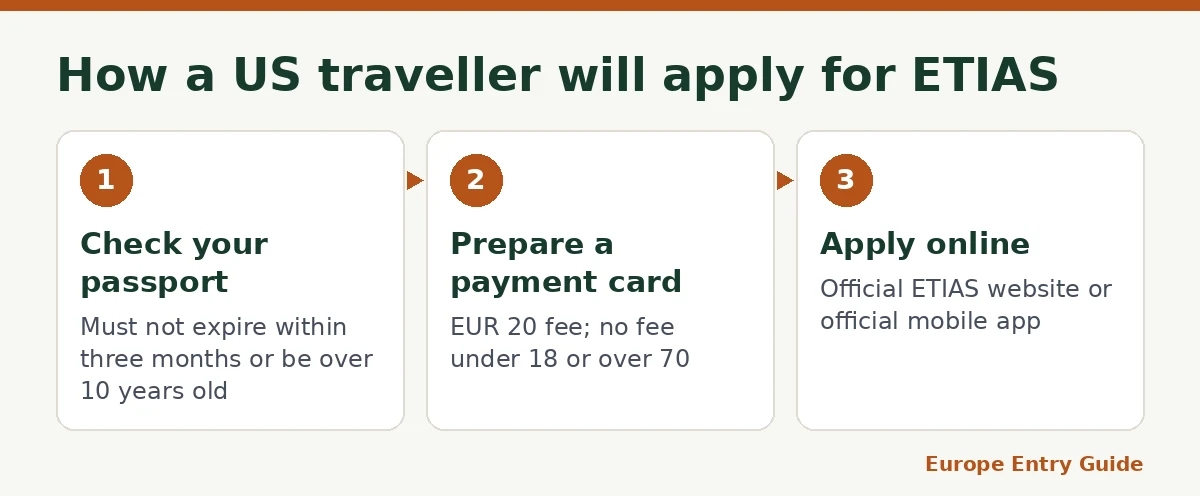
You will apply online. You will fill in the form and pay before you travel. There is only one official ETIAS website: europa.eu/etias. You will also be able to use the official mobile app.
You will need:
- a valid travel document in which visas can be affixed, such as your US passport;
- a payment card for the fee.
Your passport must not expire within three months and must not be more than 10 years old. Check the dates before you plan a trip. Full details are in ETIAS passport and document requirements.
ETIAS is a different system from the EES, which records entries and exits at the border. The two work together. See ETIAS and the EES: the difference.
Special cases
The transition period
After ETIAS starts, there will be a transition period of at least six months. You should apply during this time. If you do not have ETIAS but meet the other entry conditions, you will not be refused entry. After the transition period, you will need ETIAS to enter the 30 countries. Official information mentions an exception for travellers who come to Europe for the first time after this period.
If an application is refused
A refused applicant may receive an authorisation with limited validity. It can be issued for up to 90 days from entry, only for the countries it covers, and it can be used for more than one entry. See ETIAS refused: appeal and limited validity.
Frequently asked questions
How long will an ETIAS travel authorisation last?
Up to 3 years, or until your passport expires, whichever comes first.
Who applies for a child travelling on a US passport?
A person with parental responsibility or a legal guardian submits the application for anyone under 18. There is no fee for applicants under 18.
Will I need ETIAS for the UK or Ireland?
No. Ireland is not one of the 30 ETIAS countries. The UK is not part of ETIAS either; it has its own Electronic Travel Authorisation (ETA). For a UK perspective on ETIAS, see ETIAS for UK citizens.
More answers are on the ETIAS questions and answers page.
Sources
- Who should apply – travel-europe.europa.eu
- ETIAS will cost EUR 20 – travel-europe.europa.eu
- What you need to apply – travel-europe.europa.eu
- ETIAS timeline explained – travel-europe.europa.eu
- Travel authorisation with limited validity – travel-europe.europa.eu
This guide is general information, not legal or immigration advice. Europe Entry Guide is an independent website and is not connected with the European Union.
Found a mistake or outdated information on this page? Report it to the editors